
A Deep Dive into the CFTC’s Role in Managing Derivatives Markets
Derivatives differ from traditional securities in both their structure and regulatory oversight. Instruments like futures, options on futures, and swaps are categorized as derivatives, as their value changes in relation to an underlying asset, such as commodities or financial indexes. For instance, the market price of a wheat futures contract is shaped by the current price of wheat, the contract’s time to expiration, and expectations regarding the crop’s size and quality.
The Commodity Futures Trading Commission (CFTC) is responsible for regulating markets where these derivatives are traded, covering both consumable commodities (e.g., wheat or oil) and financial instruments (like stock indexes or swaps).
CFTC’s Core Responsibilities
The CFTC has a dual mission:
- Investor Protection: Guarding against fraud, market manipulation, and abusive practices.
- Market Integrity: Promoting transparent and competitive markets to ensure fair trading conditions.
Overview of the CFTC’s Scope
The Commodity Exchange Act (CEA), passed in 1936 and regularly updated to reflect the evolving marketplace, serves as the legal foundation for the CFTC’s operations. Although the CEA governs futures trading, the CFTC wasn’t officially formed until 1974, and the National Futures Association (NFA) — a self-regulatory body — followed in 1981.
The CFTC regulates:
- Designated Contract Markets (DCMs) or commodity exchanges
- Swap Execution Facilities (SEFs)
- Derivative Clearing Organizations (DCOs)
- Swap dealers and intermediaries across the derivatives ecosystem
Under the Dodd-Frank Act (2010), the CFTC extended its reach to over-the-counter (OTC) swaps markets, previously exempt from federal oversight.
Looking to grow your wealth?
Let me help you make your money work for you
Managed Investment Accounts – harness the expertise of professional asset management. I’ll focus on growing your wealth, so you can focus on living your best life.
Automated Trading System – effortlessly grow your capital with our automated trading solutions
How the CFTC is Organized
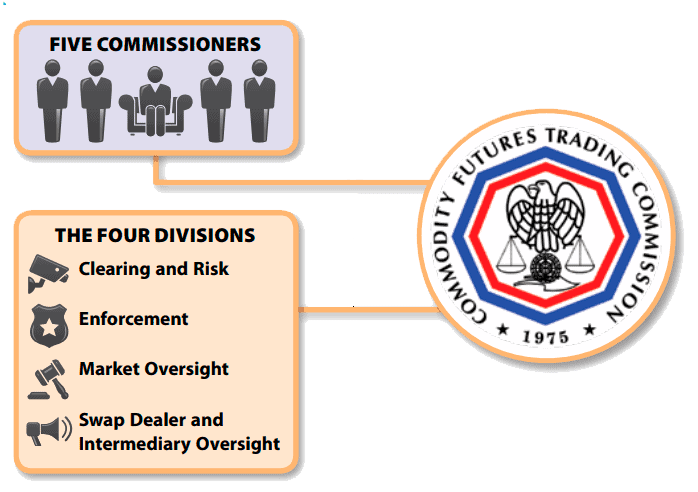
The CFTC, an independent federal agency, is governed by five commissioners appointed by the U.S. President, subject to Senate approval. No more than three commissioners may belong to the same political party, ensuring bipartisan oversight.
The agency is divided into four key divisions:
- Division of Clearing and Risk: Monitors trade clearing processes and assesses market risk.
- Division of Enforcement: Investigates and prosecutes fraud, market manipulation, and other violations.
- Division of Market Oversight: Ensures markets function smoothly and participants adhere to regulations.
- Division of Swap Dealer and Intermediary Oversight: Supervises swap dealers, intermediaries, and self-regulatory organizations like the NFA.
Keeping Markets Safe
The CFTC prioritizes consumer protection, encouraging investors to:
- Understand futures markets and the risks involved.
- Verify the credentials of brokers and intermediaries using tools like the NFA’s BASIC database.
- Beware of scams promoting quick profits with low risks, particularly in volatile markets like foreign exchange (forex), energy, and precious metals.
The CFTC also mandates intermediaries to provide risk disclosure documents—standardized warnings about the risks associated with derivatives trading. These resources are available on the NFA’s website under the Investor Information section.
Challenges in Market Manipulation
Prosecuting market manipulation remains a significant challenge, as proving intent is often difficult. Manipulation isn’t new; U.S. regulations against it date back to 1868, when “cornering” markets was first outlawed.
Evolving Regulations and Global Cooperation
As derivatives products grow more complex, regulators must constantly adapt, ensuring these instruments do not pose systemic risks. Following the 2008 financial crisis, swaps markets — previously unregulated — came under federal jurisdiction, with the CFTC and SEC sharing oversight responsibilities.
International Collaboration
Given the global nature of derivatives markets, the CFTC works closely with international regulatory bodies. It partners with agencies from the European Union and United Kingdom to combat cross-border fraud and ensure market integrity. Additionally, the CFTC is a member of the International Organization of Securities Commissions (IOSCO), which aims to harmonize global regulatory standards, though IOSCO lacks enforcement power.
What is a Swap?
A swap is a derivative contract where two counterparties agree to exchange payments based on changes in the value of specified financial instruments, such as currency exchange rates, interest rates, or commodity prices. Swaps are designed to transfer risk from one party to another.
Example of an Interest Rate Swap
Two companies agree to exchange interest payments over a set period on a fixed principal, known as the notional amount.
- Company A receives a fixed interest rate (e.g., 4%).
- Company B receives a floating rate, typically tied to a public index (e.g., LIBOR + 1%).
While Company A reduces its risk by locking in predictable income, Company B hopes to profit if interest rates rise. However, if rates fall, Company B faces the risk of reduced earnings.
Looking Ahead: The Future of Derivatives Regulation
As financial markets evolve, the CFTC will continue to play a pivotal role in protecting investors and maintaining market integrity. The rise of new financial products will require the agency to stay ahead of potential risks while fostering innovation.
In an increasingly interconnected world, international cooperation will remain essential for mitigating cross-border risks and ensuring that global derivatives markets operate efficiently and transparently.
By regulating the complex world of derivatives, the CFTC ensures that U.S. capital markets remain fair, transparent, and competitive — safeguarding both the economy and investors from undue risks.
Wishing you a great week!
Want Your Money To Grow?
Subscribe to get free research, trading lessons, and more insights.
(We do not share your data with anybody, and only use it for its intended purpose)


