
You can sever your ties to your employer’s plan by withdrawing your funds.
Deciding to move your assets out of your employer’s pension or retirement savings plan can be a strategic choice, but it requires careful consideration. On one hand, this move may provide you with greater control over your investments and increased flexibility in how you withdraw your income.
On the other hand, if your employer’s plan offers strong investment options with low fees, withdrawing your funds could lead to higher management responsibilities and costs for maintaining your account. Additionally, it’s important to note that while assets in employer-sponsored plans and IRAs are generally protected from creditor claims, once you take distributions from those accounts, that protection no longer applies.
How lump sum payouts work?
Some employer plans allow for lump-sum distributions from a defined benefit plan, while others do not. In cases where lump-sum distributions are permitted, your employer calculates the amount that the plan would have paid you as an annuity over your projected lifespan. They then determine how much the pension fund could have earned on that amount during your expected payout period. The resulting lump sum is the amount you would be entitled to, adjusted downward by a factor based on projected earnings, known as the discount rate.
In contrast, if you opt for a lump-sum payout from a defined contribution plan, such as a 401(k) or 403(b), and you are vested in the plan, you will receive the total account value minus any outstanding loans.
Your plan description will outline the process your employer will use to transfer the assets. One method involves liquidating the assets and transferring the cash either to you or directly to an IRA. Another option is an in-kind transfer, where stocks, ETFs, mutual funds, or other assets in your plan account are moved directly to your IRA custodian.
While transfers can be a convenient solution, saving you time and potential costs associated with selling and replacing assets, this option may not always be feasible—especially if you hold proprietary mutual funds from the plan provider that cannot be easily transferred.
Looking to grow your wealth?
Let me help you make your money work for you
Managed Investment Accounts – harness the expertise of professional asset management. I’ll focus on growing your wealth, so you can focus on living your best life.
Automated Trading System – effortlessly grow your capital with our automated trading solutions
Investing a lump sum
Investing a lump sum payment can present the challenge of putting your assets to work without feeling rushed or pressured to make hasty decisions. While it’s true that investing sooner can enhance your potential for growth, this advantage can diminish if you haven’t established a clear strategy for creating a diversified portfolio and selecting suitable investments.
If you don’t plan to start drawing income from the account in the next few years, consider investing in a mix of stocks and bonds. You can do this directly or through exchange-traded funds (ETFs), mutual funds, managed accounts, or other vehicles that provide both current income and long-term growth potential.
As your investments appreciate, you can gradually sell portions of them and reinvest the proceeds for income generation or capital preservation. It’s important to note that any profits will be taxed at the long-term capital gains rate, which is typically lower than the rate applied to ordinary income from a tax-deferred plan.
Your investment choices might include dividend-paying stocks, tax-exempt municipal bonds, Treasury securities, highly rated corporate bonds or bond funds, and publicly traded real estate investment trusts (REITs) or limited partnerships. Ultimately, your decisions should align with your risk tolerance and overall financial situation.
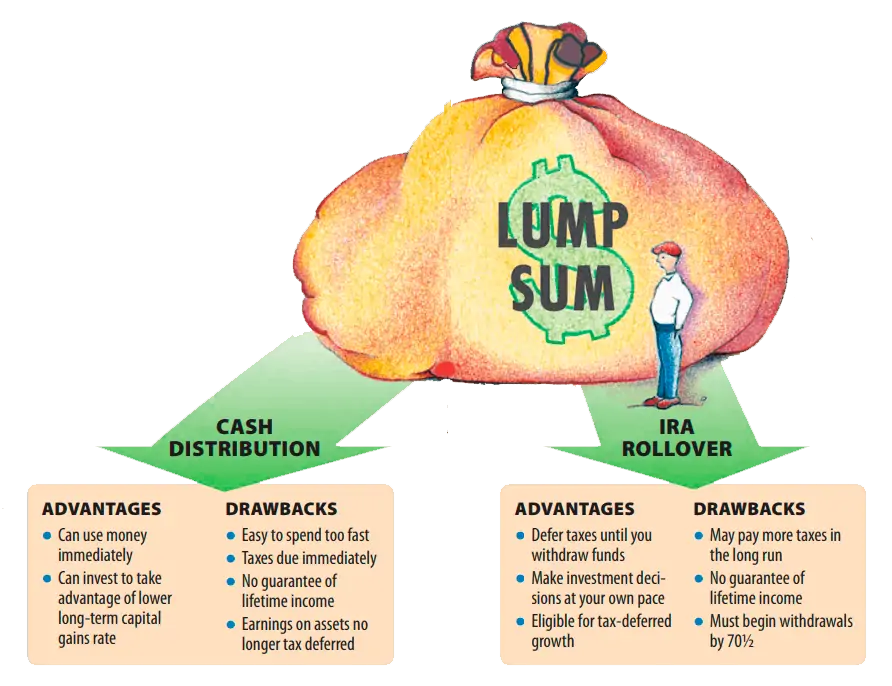
Moving to an IRA rollover
Stock distributions
Comparing earnings
Unless you plan to utilize the majority of your retirement payout immediately—an option worth careful consideration, especially if you have other income sources—you have the flexibility to roll over your account value into either a traditional or Roth IRA.
If you opt for a traditional IRA, you can transfer the amount without incurring any immediate tax liability. You can either add the funds to an existing IRA or open one or more new accounts. This allows you to diversify your investments or designate different beneficiaries for each account.
Alternatively, you can choose to pay the applicable income tax and convert your balance to a Roth IRA. Notably, there are no income limits restricting eligibility for converting plan assets to a rollover Roth IRA, unlike the contribution limits that apply to regular Roth IRAs.
If you have participated in a Roth 401(k) or 403(b), you can directly roll over those assets to a Roth IRA. A key distinction between remaining in a Roth 401(k) or 403(b) and executing a rollover is that employer plans mandate required minimum distributions (RMDs), even if those distributions are tax-free, provided your account has been open for five years and you are at least 59½. In contrast, once you convert to a Roth IRA, you are not required to take withdrawals during your lifetime.
Wishing you a great week!
Want Your Money To Grow?
Subscribe to get free research, trading lessons, and more insights.
(We do not share your data with anybody, and only use it for its intended purpose)


