
Risk avoiders and risk takers can both benefit from their interaction in the futures markets.
In futures markets, there are two main types of investors:
1. **Hedgers**: These are producers or purchasers of commodities who use futures contracts to manage the financial risks associated with their business activities. Typically, producers, such as wheat farmers, sell futures contracts to lock in prices, while users, like baking companies, buy futures contracts to secure their costs.
2. **Speculators**: These investors seek to profit from changes in market prices and are not involved in the production or consumption of the underlying commodities. They take on risk with the hope of gaining from price fluctuations.
Speculators, in contrast, trade futures with the sole aim of making a profit. They select contracts based on their expectations of future price movements. Their trading activities can influence market prices, often causing significant fluctuations, especially during periods of intense buying or selling driven by rumors, insider information, or other factors.
How do hedgers use the market?
Hedgers aim to protect themselves from price changes that could erode their profits. For example, a textile company might want to hedge against rising cotton prices due to potential issues like disease or poor weather. Suppose the company buys 100 December cotton futures contracts in August, each representing five million pounds of cotton at 58 cents per pound.
If, during the fall, the cotton crop is damaged and prices rise to 68 cents per pound, the company benefits from its hedge. It can either take delivery of cotton at the lower price of 58 cents per pound, saving $500,000 (10 cents x 5 million pounds), or sell the futures contracts at a profit and use the proceeds to offset the higher cash market price for cotton. Ideally, the hedge balances out losses in one market with gains in another, though achieving a perfect hedge is rarely possible.
Investing in futures is different from investing in stocks, bonds, and mutual funds because futures markets are zero sum markets. That means for every dollar somebody makes (before commissions), somebody else loses a dollar. Put bluntly, that means that any gain is at somebody else’s expense.
The role of speculators
Speculators aim to profit from price movements in the futures market by making strategic bets. For example, a speculator might invest heavily in orange juice futures in November, anticipating that a freeze could damage the Florida orange crop and drive up the price of orange juice and its related futures contracts.
If the speculator’s prediction proves correct and a harsh winter causes prices to rise, the futures contracts will be worth more than what was initially paid. The speculator can then sell the contracts at a profit. Conversely, if the prediction is wrong and a bumper crop leads to a market crash, the speculator could face significant losses as prices plummet.
Looking to grow your wealth?
Let me help you make your money work for you
Managed Investment Accounts – harness the expertise of professional asset management. I’ll focus on growing your wealth, so you can focus on living your best life.
Automated Trading System – effortlessly grow your capital with our automated trading solutions
Speculators are indispensable
Speculators play a vital role in the futures market by creating a symbiotic relationship with those looking to manage risk. While hedgers, who are involved in inherently risky businesses, seek to avoid uncertainty, speculators are willing to accept it.
For instance, without speculators betting on both rising and falling orange juice prices, an orange juice producer couldn’t safeguard against sharp cost increases from a freeze, and orange farmers wouldn’t be able to secure enough income in a good year to cover their production expenses. Speculators help balance the market, making it possible for hedgers to protect themselves and for producers to benefit from favorable conditions.

Speculators also provide liquidity. If only those who produced or used the commodities were trading, there would not be enough activity to keep the market going. If buy and sell orders were matched slowly, it would diminish the protection that hedgers gain from a market that quickly reflects changes in the cash market.
Influences on futures contract prices
The price of a futures contract is shaped by a variety of factors, including natural and political events, government economic data, and the activities and sentiments of speculators.
Economic data, such as new home sales, can significantly impact futures prices. For example, news on new home sales affects lumber futures as both hedgers and speculators adjust their expectations for lumber demand in the construction industry.
Futures contract prices also incorporate storage, insurance, and other carrying costs associated with holding the commodity until delivery. Generally, contracts with longer durations are priced higher due to these costs, a phenomenon known as contango. Conversely, in an inverted market or backwardation, limited short-term supply can drive up prices for near-term contracts while decreasing prices for contracts with longer durations.
Despite their differing objectives, hedgers and speculators coexist in the market, and fluctuations in futures prices affect both groups.
Options on futures
Buying a put or call option on a futures contract enables an options buyer to speculate on a price change with limited risk. The most the buyer can lose is the option premium, or the cost of the option.
Purchasing a call option on a futures contract grants the buyer the right, but not the obligation, to buy the underlying futures contract at a specified price during the option’s life.
Conversely, buying a put option gives the buyer the right to sell the underlying futures contract. An options buyer is not required to exercise the option but can choose to do so before expiration if it’s an American-style option.
For example, if a buyer anticipates rising gold prices, they might purchase a call option on gold futures. If gold prices increase, the buyer can exercise the option, purchase the gold futures at the agreed price, and then sell an offsetting contract at the higher market price, earning a profit equal to the price difference minus the option premium.
If gold prices fall, the buyer can let the option expire, incurring only the cost of the option premium. This strategy limits potential losses compared to futures contracts, where losses can be unlimited.
Examples of hedgers, users and speculators positions
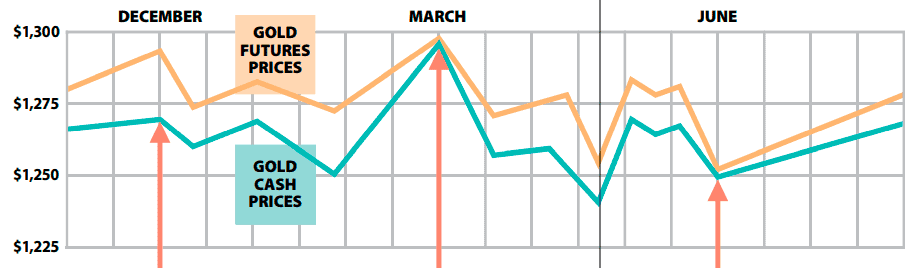
DECEMBER
Gold is $1,270 an ounce in the cash market and $1,285 for the June contract
In December, the price of gold in the cash market — what a buyer would pay for immediate delivery — is $15 less than the price of the June contract.
Producers (hedgers)
Gold producers hedge by selling futures contracts. The gold producers sell June futures contracts because they won’t have gold ready for delivery until then.
Earned in December sale $ 1,285
Users (hedgers)
Gold users hedge by buying futures contracts. The gold users buy June futures contracts because that’s when they need the gold.
Cost of December buy – $ 1,285
Speculators
Speculators buy gold futures contracts if they think the price is going up.
Cost of December buy – $ 1,285
MARCH
Gold is $1,295 an ounce in the cash market. The June contract is selling for $1,298
In March, the price of gold has gone up to $1,295 in the cash market. The June futures contract is selling for $1,298.
Producers (hedgers)
The producers can’t sell their gold because it isn’t ready yet. They do nothing.
Users (hedgers)
This upswing in the cash price is exactly what the users were trying to protect themselves against. They wait for the expiration date.
Speculators
The speculators sell, thinking gold has reached its peak. One clue is that the contract price is so close to the cash price. If speculators thought higher prices in the cash market were likely in the near future, they would be willing to pay higher prices for futures contracts.
This time the speculators made money in the market if they sold in March when the contract price reached its peak.
Priced from March sell $ 1,298
Cost of December buy – 1,285
Result of trade [profit] $ 13
JUNE
Contracts expire when gold is $1,250 an ounce in the cash market and $1,252 in the futures market
In June, when the contract expires, both the producers and the users equalize their profit or loss in the futures market through offsetting trades in the cash market
Producers (hedgers)
Because the price of the gold futures contract had dropped, the producers made money on the offsetting trade.
Earned in December sell $ 1,282
Cost of June buy – 1,252
Result of trade [profit] $ 33
Even though producers had to sell their gold in the cash market for less than the anticipated price, the profit from their futures trades gave them the expected level of profit.
Earned in cash market $ 1,250
Futures profit 33
Gross profit $ 1,283
Users (hedgers)
The users lost money on the futures contracts because it cost more to sell the offsetting contracts than they had paid to buy.
Earned in June sell $ 1,252
Cost of December buy – 1,285
Result of trade [loss] – $ 33
Since it cost the users less to buy gold in the cash market than they had expected, the total cost was what they anticipated.
Cost in cash market $ 1,250
Cost of futures trade + 33
Actual cost of gold $ 1,283
In any futures contract, the profit or loss for hedgers can be reversed based on fluctuations in the futures price. Ultimately, however, their gains or losses in the futures market are offset by corresponding changes in the cash market. Speculators, on the other hand, might experience frequent losses, potentially more than gains, depending on price movements and their timing of entry and exit from the market.
Rice tickets
The origins of futures contracts can be traced back to 17th-century Japan, where rice tickets were used by landlords to manage their rice rents. These tickets, essentially warehouse receipts, gave holders the right to a specific quantity and quality of rice at a future date.
Landlords sold these receipts to generate steady secondary income from their stored rice. Buyers of the tickets could either redeem them for rice at the designated time or sell them for a profit to others. Similar to modern futures contracts, these tickets had no intrinsic value themselves but represented a means to profit from fluctuations in the value of the underlying commodity — in this case, rice.
Understanding Hedgers And Speculators Role In Futures Market by Inna Rosputnia
Wishing you a great week!
Want Your Money To Grow?
Subscribe to get free research, trading lessons, and more insights.
(We do not share your data with anybody, and only use it for its intended purpose)


