
You can limit your risk exposure by using two or more options on the same stock.
A spread is an options strategy that involves two simultaneous transactions. You buy one option and write another on the same stock or index. These options are identical in most respects but differ in one key aspect, such as the strike price or expiration date.
The most common type of spread is the vertical spread, where one option has a higher strike price than the other. The difference between these strike prices is referred to as the spread. Various spread strategies are suited to different market forecasts: a bear spread is used when you expect the stock price to decline, while a bull spread is employed when you anticipate an increase in the stock price.
How do you hedge with spreads?
If stock XYZ is trading at $45, Investor A sells a call option with a $40 strike price and buys a call option with a $55 strike price. She receives $720 for selling the in-the-money call and pays $130 for the out-of-the-money call she purchases. This results in a net credit of $590.
Investor B, on the other hand, writes a $40 call on XYZ and receives the same $720. However, since his position is a naked call, his net investment is the margin his brokerage firm requires to cover the potential risk.
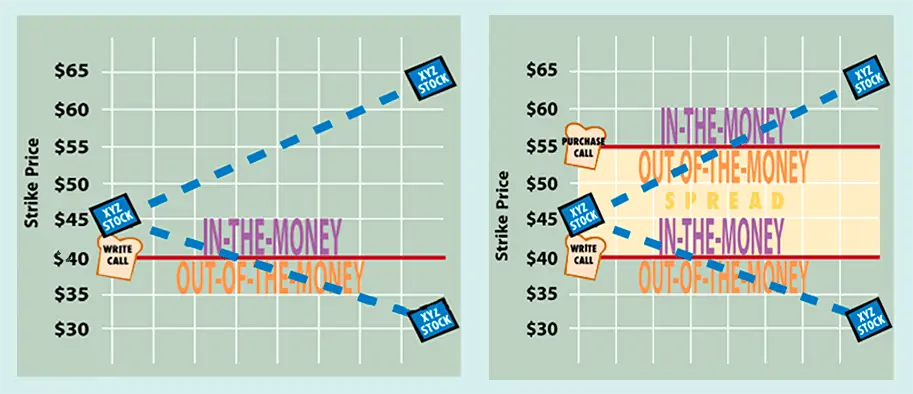
If the stock price rises to $60 at expiration:
- Investor A: Her short call is in-the-money, requiring her to sell 100 XYZ shares at $40 each. However, her long call is also in-the-money, allowing her to buy those same shares at $55 each. This results in a net loss of $15 per share, or $1,500 total. After factoring in the $590 premium she received, her maximum potential loss is reduced to $910.
- Investor B: His short call is in-the-money, forcing him to sell 100 XYZ shares at $40 each, resulting in a $2,000 loss compared to the market price. However, the $720 premium he received reduces his maximum potential loss to $1,280.
If the stock price falls below $40 at expiration:
- Investor A: Both of her options expire out-of-the-money, meaning she keeps the $590 premium, which is her maximum profit.
-
Investor B: His option also expires out-of-the-money, allowing him to keep the entire $720 premium as his profit.
Looking to grow your wealth?
Let me help you make your money work for you
Managed Investment Accounts – harness the expertise of professional asset management. I’ll focus on growing your wealth, so you can focus on living your best life.
Automated Trading System – effortlessly grow your capital with our automated trading solutions
Each options transaction within a strategy is referred to as a “leg.” Most options spreads involve two legs, where you simultaneously execute two transactions. However, some strategies involve three or more legs, incorporating additional options to create more complex positions.
What are the benefits?
Many options investors use spreads because they provide a double hedge, limiting both potential profit and loss. Investors interested in more aggressive options strategies that might expose them to significant potential losses can manage those risks by including them as one leg of a spread. The trade-off is that potential profits are also capped. Think of spreads as a form of self-defense: just as you might use an options position to protect against losses in a stock position, you can use an options spread to protect against losses in another options position.
Credit or debit?
If, like Investor A, you receive more for the option you write than you pay for the option you buy, you’ve established a credit spread. The difference between the premiums is a credit that gets deposited into your brokerage account when you open the position. The typical goal of a credit spread is to have both options expire worthless, allowing you to keep the credit as profit.
Conversely, if you pay more for your long option than you receive for your short option, you’re dealing with a debit spread. You will need to pay the difference between the two premiums to your brokerage firm when opening the position. The usual objective of a debit spread is for the stock to move beyond the strike price of the short option, enabling you to realize the maximum value of the spread.
Credit spread:
premium you receive > premium you pay
Debit spread:
premium you receive < premium you pay
Are you qualified?
While spreads are not always speculative or aggressive, they are complex strategies that may not suit every investor. Brokerage firms often have approval levels for debit and credit spreads to ensure that you have the financial qualifications and sufficient investing experience. Additionally, managing spreads as expiration approaches requires time and attention, so it’s important to be prepared for the challenge if you decide to use them.
More types of spreads
A calendar spread involves buying one option and writing another with the same strike price but different expiration dates. This strategy is typically neutral, aiming to profit from time decay and differences in volatility between the two expiration dates.
A straddle involves buying or writing both a call and a put option on the same underlying asset, with the same strike price and expiration date. Buyers of a straddle expect significant movement in the underlying stock, but are uncertain of the direction. Sellers, however, anticipate that the stock price will remain stable at the strike price.
A strangle involves buying or writing a call and a put option with the same expiration date but different strike prices, both of which are out-of-the-money. Strangle holders hope for a substantial price move in either direction, while strangle writers hope the price remains relatively stable and doesn’t move significantly from the strike prices.
Steps of executing a strategy
-
Choose the Underlying Security: Select the stock or index on which you will buy and write the options.
- Determine Strike Prices and Expiration Dates: Decide on the strike prices and expiration dates for the options based on your expectations of the stock’s movement and the timeframe for that movement.
- Calculate Potential Profit and Loss: Assess the maximum profit and maximum loss for your strategy, including the conditions under which these outcomes might occur. Setting realistic expectations is crucial for effective options investing.
-
Execute Transactions Through a Margin Account: Complete the transactions using a margin account with your brokerage firm. The minimum margin requirement for a spread is typically the difference between the two strike prices, multiplied by the number of shares covered.
How To Profit With Options Spread Strategies? by Inna Rosputnia
Wishing you a great week!
Want Your Money To Grow?
Subscribe to get free research, trading lessons, and more insights.
(We do not share your data with anybody, and only use it for its intended purpose)


