
Private equity refers to investments made directly into private companies or the buyout of public companies to take them private. It involves raising private funds—typically through limited partnerships—and deploying this capital in companies at various stages of development, aiming for significant returns over time.
Private equity firms are known to focus primarily on two key areas:
- Venture Capital (VC): Investments in early-stage companies.
- Buyouts: Acquisition and restructuring of mature businesses.
How Private Equity Works
- Raising Capital:
Private equity firms collect funds from high-net-worth individuals and institutional investors (e.g., pension funds, banks, endowments). Investors are typically required to meet SEC standards to qualify as accredited investors. - Fund Structure:
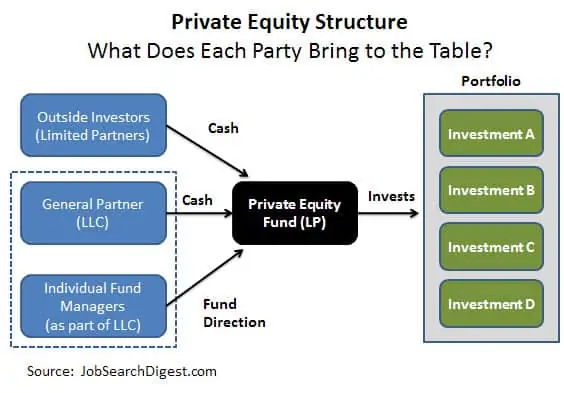
- The fund is usually organized as a limited partnership, where:
- General Partners (GPs) manage the fund and actively make investment decisions.
- Limited Partners (LPs) contribute capital but have no management role and limited liability.
- GPs earn a management fee (typically 1-2%) and a share of profits (known as “carry”), often 20-30%.
- The fund is usually organized as a limited partnership, where:
- Types of Private Equity Investments:
- Venture Capital (VC):
VC firms invest in startups or small companies at various stages:- Early-stage: Startups developing products or intellectual property.
- Expansion-stage: Companies scaling operations or entering new markets.
- Late-stage: Businesses nearing IPO or acquisition.
- Buyouts:
Buyout firms acquire established companies, often through leveraged buyouts (LBOs), using both investor cash and significant debt. They restructure the companies to enhance profitability before selling them or taking them public.
- Venture Capital (VC):
-
Control and Management:
Private equity firms play an active role in restructuring businesses, streamlining operations, or helping companies grow. In buyouts, taking a company private allows changes to be implemented without public scrutiny.
Looking to grow your wealth?
Let me help you make your money work for you
Managed Investment Accounts – harness the expertise of professional asset management. I’ll focus on growing your wealth, so you can focus on living your best life.
Automated Trading System – effortlessly grow your capital with our automated trading solutions
Examples of Private Equity Investment
- Early-Stage VC Investment:
A VC fund invests in a startup developing a new AI product, providing capital to help the company scale. If the business succeeds, the VC can exit through an IPO or acquisition. - Leveraged Buyout (LBO):
A buyout firm acquires a struggling retail chain by using both investor funds and debt. The firm restructures operations and later sells the company at a profit.
Investment Access & Fees
- Minimum Investment Requirements:
High minimum thresholds restrict participation to wealthy individuals and institutional investors. However, retail investors may access private equity indirectly through:- Feeder funds offered by brokerages.
- Funds of funds (though this involves additional fees).
-
Fee Structure:
Investors typically pay 1-2% management fees and 20-30% of profits to the fund managers.
Exit Strategies in Private Equity
- Initial Public Offering (IPO):
A private company goes public by listing on a stock exchange. Early investors receive shares in the newly public company, but they may be restricted from selling these shares immediately due to a lock-up period (commonly six months to two years). - Merger or Acquisition:
This is the most common exit strategy. The private company is sold or merged with another company, and investors may receive cash, shares in the new company, or both. - Secondary Buyout:
One private equity firm sells its stake to another firm, allowing investors in the original fund to cash out.
Advantages and Challenges of Private Equity
Advantages:
- High Returns:
Successful private equity investments can generate substantial profits, especially in high-growth ventures or effective turnarounds. - Active Management:
Private equity firms provide expert management and strategic direction, which can improve a company’s performance.
Challenges:
- Illiquidity:
Investors cannot easily exit before the investment term (often 8-10 years) ends. - High Risk:
Some investments, particularly in startups, may fail, resulting in significant losses. - Complex Fee Structures:
Multiple layers of fees reduce net returns for investors. - Limited Access:
High minimum investments and accreditation requirements make private equity funds inaccessible to many individuals.
Regulations Governing Private Equity
- SEC Registration:
Private equity funds managing more than $150 million must register as investment advisers with the SEC. - Accredited Investors:
Most private equity funds require investors to meet SEC’s accreditation standards due to the high risks involved.
Conclusion
Private equity provides opportunities for significant financial returns by investing in businesses with growth potential or turnaround opportunities. However, it requires patience, as investments are typically illiquid and may take years to mature. Due to the high risks and complex fee structures, private equity remains an investment class primarily for wealthy investors and institutions, though some indirect options are available for others through feeder funds or funds of funds.
Wishing you a great week!
Want Your Money To Grow?
Subscribe to get free research, trading lessons, and more insights.
(We do not share your data with anybody, and only use it for its intended purpose)


