
Today, I want to introduce you to one of the most precise trading strategies— the “Oops” pattern, developed by the legendary trader Larry Williams. While no strategy is foolproof in the markets, this one boasts a high accuracy rate of 70-80%. Of course, a lot depends on how you manage your money, which is why traders using the same strategy can see different outcomes. But we’ll dive into money management later.
What is behind the Oops pattern? Trading strategy basics
Let’s dive into the Oops trading strategy, which has delivered solid returns on the managed trading accounts I’ve handled. Why is it called “Oops”? Well, I didn’t coin the name, but it likely comes from how this strategy capitalizes on crowd emotions and psychology, particularly when the big players use these to their advantage. The strategy often kicks in after some “noise news” causes the market to open significantly lower or higher than the previous day’s range, signaling panic or greed among retail traders.
This scenario creates a prime opportunity for the big players to place contrarian trades, profiting from the emotional overreactions of smaller investors. Essentially, it’s a gap trading strategy, with the gap driven by emotional reactions. As reality sets in, retail traders often realize their mistake… Oops!
Like most strategies I employ, this one is ideal for swing traders—I’m not a big fan of day trading.
The Oops pattern is easy to spot on a chart. Simply look for these two steps:
- The daily candle opens below the previous day’s low.
- The daily candle opens above the previous trading day’s high.
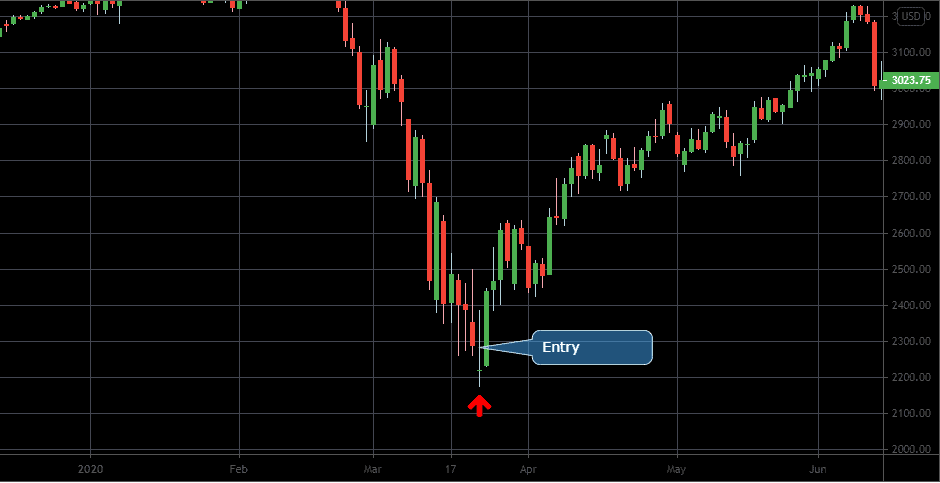
Here is how the Oops pattern works for a buy (opposite is valid for sell)
First, let me clarify that the Oops pattern works effectively for both stocks and commodities. The key is to focus on instruments that have been in a downtrend for several days. The Oops strategy is most accurate during the accumulation phase when major players are attempting to shake out retail traders. This pattern often appears during a Wyckoff Spring. However, avoid using the Oops strategy if the market is merely bouncing within a channel—it simply won’t work in that scenario.
Looking to grow your wealth?
Let me help you make your money work for you
Managed Investment Accounts – harness the expertise of professional asset management. I’ll focus on growing your wealth, so you can focus on living your best life.
Automated Trading System – effortlessly grow your capital with our automated trading solutions
In the final stage of a downtrend, the market must gap down significantly below the previous day’s low—this marks the next step in the Oops formation. As the market reassesses the news, the price begins to rise, eventually crossing back above the previous day’s low. This crossover serves as the buy signal, and a long trade should be initiated at this point. The stop-loss should be set just below the low of the current day.
In conclusion
OOPS Trading Strategy. Most essential pattern by Inna Rosputnia
Wishing you a great week!
Want To Make Your Trading More Profitable?
Subscribe to get free research, trading lessons, and more insights.
(We do not share your data with anybody, and only use it for its intended purpose)


